

How to Identify When a Motorcycle Brake Hose Needs Replacement
Motorcycle brake hoses are essential components of hydraulic braking systems. They transfer brake fluid pressure from the master cylinder to the brake caliper, allowing the braking system to operate as designed. Over time, aging, environmental exposure, incorrect installation, and mechanical damage may affect hose condition and reliability.
Knowing when to replace a motorcycle brake hose is important for riders, repair workshops, motorcycle parts distributors, and aftermarket suppliers. Early identification of hose damage can help prevent further deterioration and reduce the risk of braking system failure.
This guide explains the most common warning signs of a damaged motorcycle brake hose, factors that influence service life, inspection procedures, and important considerations when selecting replacement or upgraded motorcycle brake lines.
1. Seven Warning Signs That a Motorcycle Brake Hose Needs Replacement
1.1 Cracks on the Outer Hose Surface
Cracking is one of the visible signs that a brake hose may have deteriorated. Rubber materials can age because of heat, sunlight, environmental exposure, and repeated flexing during normal vehicle operation.
What to Look For
- Small cracks or splits along the outer hose surface.
- Rubber that appears hardened or brittle.
- Visible damage near bends, fittings, or mounting points.
- Cracks that become more noticeable when the hose changes position during inspection.
If a brake hose shows cracking or other signs of deterioration, have it inspected and replace it when required by the manufacturer's service criteria. Do not wait for a visible leak to develop before addressing a damaged hose.
1.2 Brake Fluid Leakage
Brake fluid leakage is a serious warning sign that requires immediate attention. A leak may originate from a damaged hose, a faulty fitting, a sealing washer, or another part of the hydraulic braking system.
Possible Symptoms
- Wet areas or fluid residue around hose connections.
- A brake fluid level that decreases without an identified cause.
- Visible fluid on the hose surface or nearby components.
- A brake lever that loses pressure or feels abnormal.
Stop riding if a brake fluid leak is suspected. Have a qualified technician identify the source and replace defective components using the correct parts and installation procedures. Simply tightening a fitting without identifying the cause may not resolve the problem.
1.3 Swelling or Bulging Under Pressure
A hose that develops abnormal swelling or localized bulging may have internal structural damage. This condition can compromise the hose's ability to withstand hydraulic pressure.
Inspect the hose for unusual changes in shape, especially near connection points and sections exposed to heat or mechanical stress. Any suspected bulging should be assessed by a qualified technician.
Do not continue using a hose that shows abnormal expansion or structural damage. Replace it with an assembly that meets the motorcycle's required pressure, temperature, and compatibility specifications.
1.4 Abrasion and External Damage
Brake hoses may rub against the frame, fork, wheel, suspension, or other nearby components if routing or clearance is incorrect. Repeated contact can damage the outer covering and eventually compromise the hose structure.
Common Causes
- Incorrect hose length after motorcycle modification.
- Improper fitting orientation or hose routing.
- Missing or incorrectly positioned retaining clips.
- Contact with sharp edges or moving components.
- Damage caused by stones, debris, or unsuitable maintenance tools.
Check the entire hose route and confirm adequate clearance throughout steering and suspension movement. Replace hoses that fail inspection and correct the underlying routing problem to prevent similar damage to the replacement assembly.
1.5 Corrosion Around Metal Fittings
Brake hose fittings may be exposed to moisture, road salt, cleaning chemicals, and other environmental contaminants. Corrosion can damage fitting surfaces, make maintenance difficult, and affect connection integrity.
Inspect the fittings for rust, pitting, deformation, or other visible damage. Also examine the sealing interfaces and surrounding areas for signs of leakage.
Replace fittings or complete assemblies when necessary, using compatible components with suitable materials and surface protection. The correct replacement depends on the original connection design and the motorcycle manufacturer's requirements.
1.6 A Soft or Spongy Brake Lever
A soft or spongy brake lever can indicate air in the hydraulic system, fluid problems, worn components, leakage, or excessive hose expansion. It does not automatically mean the brake hose is defective.
A qualified technician should inspect the complete braking system, including the master cylinder, brake caliper, fluid condition, seals, and hose assembly. If the hose is damaged or unsuitable for the application, replace it with a correctly specified product.
A properly engineered reinforced brake hose may help control hose expansion in compatible applications. However, upgrading the hose cannot compensate for air in the system or defects elsewhere in the braking system.
1.7 Incorrect Routing After a Motorcycle Modification
Changing handlebars, front forks, brake calipers, or other components may alter the original brake hose routing. A hose that was suitable for the standard motorcycle may become too short, too long, twisted, or poorly positioned after modification.
Inspect the hose at full steering lock and throughout the specified suspension movement. It should not stretch, kink, become trapped, or contact the tire and other moving parts.
When a different configuration is required, a correctly specified custom Motorcycle Brake Lines assembly may help achieve suitable fitment. The finished installation must be verified by a qualified technician before the motorcycle returns to service.
2. How Long Does a Motorcycle Brake Hose Last?
There is no single replacement interval that applies to every motorcycle brake hose. Service life depends on the hose construction, vehicle manufacturer's maintenance schedule, operating conditions, installation quality, and environmental exposure.
2.1 Follow the Manufacturer's Replacement Schedule
Check the motorcycle owner's manual and maintenance documentation for the recommended brake hose inspection and replacement intervals. Some vehicles specify scheduled replacement regardless of whether obvious damage is visible.
Do not use appearance alone to determine whether an older hose remains suitable for service. Follow the manufacturer's instructions and replace the hose earlier when inspection identifies damage or deterioration.
2.2 Consider Climate and Road Conditions
Motorcycles operating in hot, humid, coastal, dusty, or heavily polluted environments may encounter different conditions from motorcycles used in mild climates.
For example, moisture and corrosive contaminants can affect metal fittings, while heat and sunlight can contribute to the deterioration of exposed materials. Regular inspection is especially important when motorcycles operate in demanding environments.
2.3 Check Vehicle Usage and Maintenance History
Frequent use, repeated exposure to harsh conditions, improper cleaning, and previous installation problems can influence hose condition. Motorcycles with unknown maintenance histories should receive a careful brake system inspection before regular use.
When there is uncertainty about the hose's condition or replacement history, consult a qualified technician rather than assuming that the component is safe because it has no obvious external leak.
3. How to Inspect a Motorcycle Brake Hose
3.1 Perform a Visual Inspection
Inspect the full visible length of the hose, including the areas around fittings, bends, clips, and mounting points. Look for cracks, swelling, leakage, abrasion, corrosion, kinks, or exposed reinforcement.
Follow the motorcycle manufacturer's inspection procedures. Do not bend, twist, or manipulate a pressurized brake hose beyond the permitted service procedure in an attempt to reveal hidden damage.
3.2 Check the Fittings and Connections
Examine connection points for visible damage, fluid residue, corrosion, and incorrect alignment. Fittings must match the specified thread, sealing method, and connection design.
If a connection appears damaged or leaks, do not continue riding. Have the problem corrected using compatible components and the prescribed installation procedure.
3.3 Verify Hose Routing and Clearance
Check that the hose does not rub against the tire, fork, frame, or other components. Verify clearance at full steering lock and throughout the specified suspension travel.
Incorrect routing should be corrected before the motorcycle is returned to service. Replacing the hose without addressing the underlying clearance problem may cause the replacement to deteriorate prematurely.
3.4 Check Brake Fluid and Lever Operation
Inspect the brake fluid level and condition according to the manufacturer's maintenance instructions. Confirm that the brake lever operates normally and that there are no visible leaks.
Any abnormal lever feel, unexplained fluid loss, or change in braking response requires professional diagnosis. A visual inspection alone cannot confirm the internal condition or pressure performance of a brake hose.
4. Choosing a Replacement Motorcycle Brake Hose
When replacement is necessary, selecting a hose that matches the original specifications is essential. An aftermarket assembly should be evaluated by its complete design, compatibility, documented performance, and fitment rather than by material name or appearance alone.
4.1 Rubber Brake Hose Assemblies
Rubber brake hoses are suitable for many applications when the complete assembly meets the motorcycle's requirements. Buyers should check material specifications, dimensions, pressure ratings, temperature limits, fitting design, and brake fluid compatibility.
A replacement Rubber Brake Hose Assembly should be intended for the specific braking application and meet the relevant requirements for that vehicle and market.
4.2 PTFE and Teflon Brake Hoses
PTFE inner tubes are used in certain reinforced hydraulic brake hose designs. Their suitability depends on the complete assembly, including reinforcement, end fittings, seals, dimensions, and testing.
When considering a Teflon Brake Hose or PTFE Brake Line Assembly, confirm the manufacturer's technical specifications and ensure that the product is designed and qualified for the intended motorcycle braking system.
4.3 Stainless Steel Braided Brake Hoses
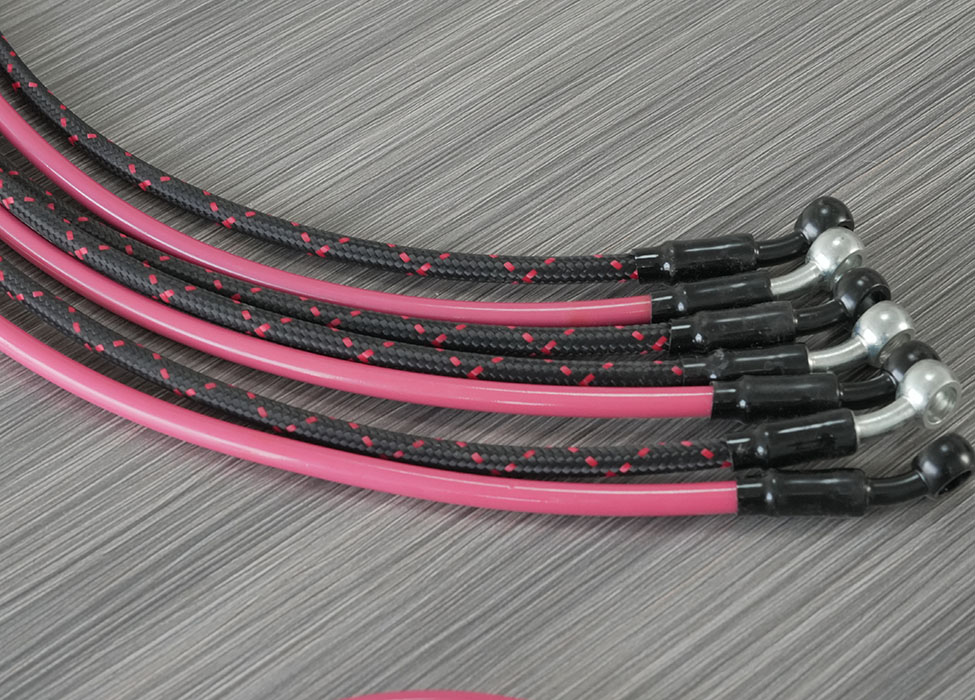
Stainless steel braided reinforcement can provide additional mechanical support and help control hose expansion in suitable designs. These assemblies are often considered for aftermarket motorcycles and customized brake configurations.
Buyers should verify pressure performance, fitting quality, corrosion protection, abrasion resistance, and application compatibility. Stainless steel braid alone does not guarantee that a hose is suitable for every motorcycle.
4.4 Nylon Products and Application Suitability
Nylon tubing is used in many automotive and industrial applications, but ordinary nylon tubing is not automatically suitable for hydraulic motorcycle brakes.
Before selecting a Nylon Brake Hose or Nylon Brake Hose Assembly, verify that the specific product is expressly designed, tested, and approved for the intended braking application. Never substitute general-purpose tubing for a qualified brake hose based solely on its dimensions.
5. Why Quality Matters When Sourcing Motorcycle Brake Hoses
For motorcycle parts importers, wholesalers, repair networks, and aftermarket brands, replacement hose quality affects fitment, reliability, and customer satisfaction. Purchasing decisions should be based on technical evidence and consistent manufacturing rather than price alone.
5.1 Material Quality and Compatibility
The inner tube, reinforcement, protective covering, fittings, and seals must be suitable for the intended application. Ask suppliers for relevant material specifications and compatibility information.
5.2 Fitting and Crimping Quality
Incorrect fitting dimensions or inconsistent crimping may compromise assembly integrity. A reliable manufacturing process should include suitable process controls, dimensional inspection, and testing appropriate to the product design.
5.3 Pressure Testing and Quality Documentation
Request test documentation relevant to the exact assembly and its intended use. Depending on the applicable requirements, this may include pressure testing, dimensional verification, and other specified performance evaluations.
Do not assume that one test result or general supplier quality claim establishes compliance with every motorcycle application or destination-market requirement.
5.4 Customization for Different Motorcycle Models
Aftermarket and OEM buyers may require different hose lengths, fitting angles, connection types, protective coverings, or packaging. These specifications should be confirmed before production begins.
Custom brake lines must maintain correct routing and clearance and satisfy the same relevant hydraulic performance and safety requirements as other qualified assemblies.
6. Frequently Asked Questions About Motorcycle Brake Hose Replacement
What are the most common signs of a damaged motorcycle brake hose?
Common warning signs include cracking, swelling, fluid leakage, abrasion, corrosion around fittings, and incorrect routing. A soft brake lever can also indicate a braking system problem, although it may have causes unrelated to the hose.
Can I continue riding with a cracked brake hose?
No. A cracked or structurally damaged brake hose requires prompt professional assessment. Do not ride the motorcycle if the hose may be unsafe or if braking performance is abnormal.
Should I replace both front and rear brake hoses at the same time?
It depends on the motorcycle manufacturer's recommendations, the condition of each hose, and the inspection results. Replace all hoses required by the maintenance schedule or found to be defective. A qualified technician can determine whether additional replacement is appropriate.
Are braided brake hoses maintenance-free?
No. Braided brake hoses still require regular inspection for abrasion, corrosion, damaged coverings, leaks, and fitting problems. Follow the maintenance schedule and replacement requirements for the specific product and motorcycle.
What information is needed to order replacement motorcycle brake lines?
Useful information includes the motorcycle make, model, year, required hose length, fitting type, thread specifications, connection angles, material requirements, order quantity, and destination market. Drawings, original samples, and accurate photographs can help confirm the required configuration.
7. Conclusion: Replace Damaged Motorcycle Brake Hoses Before Problems Become Serious
Cracking, leakage, swelling, abrasion, corrosion, and incorrect routing are important warning signs that a motorcycle brake hose may need replacement. Regular inspections and timely maintenance help identify problems before they develop into more serious braking system faults.
For riders, workshops, distributors, and OEM purchasing teams, the right replacement starts with accurate specifications, compatible materials, correct fittings, and documented product quality. Rubber assemblies and reinforced PTFE brake lines should be selected according to the requirements of the intended motorcycle.
When sourcing motorcycle brake hoses in bulk, verify application compatibility, manufacturing consistency, relevant testing, and destination-market requirements. A properly specified and correctly installed brake hose is an essential part of maintaining a reliable hydraulic braking system.