

Complete Guide to PTFE Stainless-Braided Brake Hoses
Executive summary: This guide provides a concise, engineer-level overview of PTFE (Teflon) stainless-braided brake hoses. It explains material construction, how PTFE assemblies improve braking performance relative to rubber hoses, and gives a practical specification, procurement and installation checklist for distributors, fleet buyers and performance shops.
Material system and functional rationale
PTFE inner liner — hydraulic stability and chemical resistance
Dimensional stability
The PTFE (polytetrafluoroethylene) inner liner provides a smooth hydraulic bore with very low volumetric expansion. Under transient pressure loads PTFE maintains bore geometry far better than elastomers, reducing hydraulic compliance and improving actuation fidelity.
Chemical compatibility
PTFE resists degradation from DOT 3/4/5.1 brake fluids and most contaminants. This chemical inertness reduces internal swelling, delamination and permeability that commonly degrade rubber hoses over time.
Stainless-steel braid — radial restraint and abrasion protection
Braid design considerations
A tightly woven stainless braid limits radial expansion of the PTFE core and protects against mechanical damage. Braid metallurgy, weave density and braid angle are design variables that directly influence burst rating and fatigue (impulse) life.
Outer jacket options
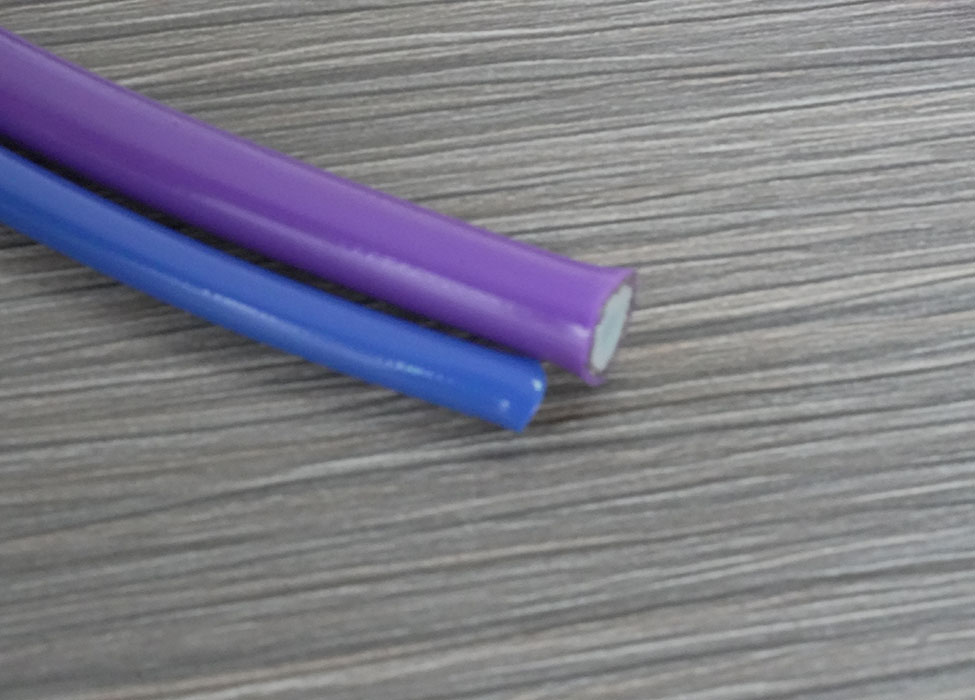
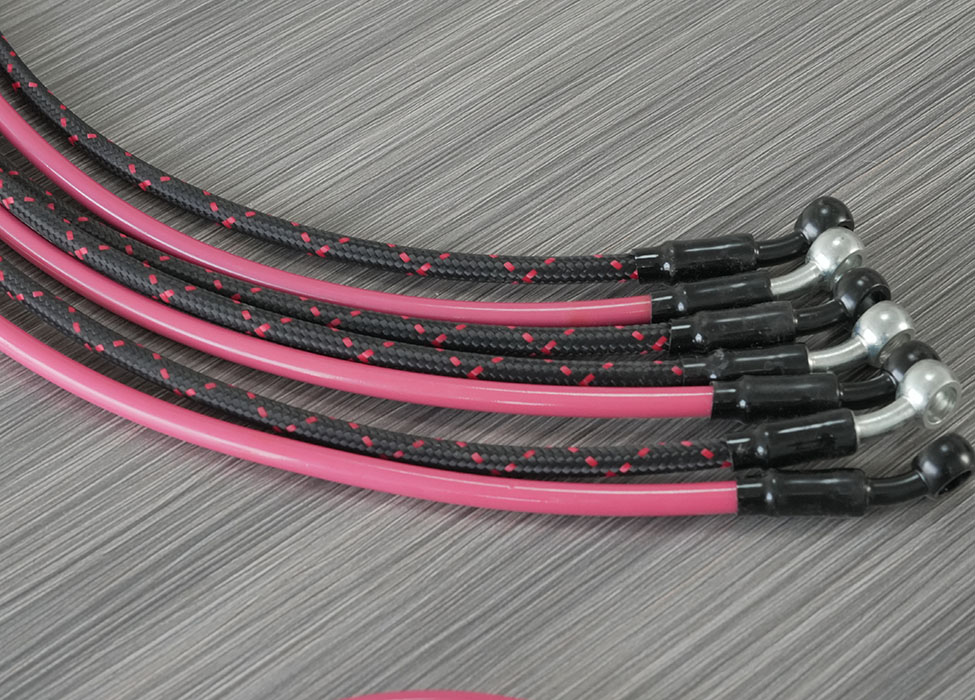
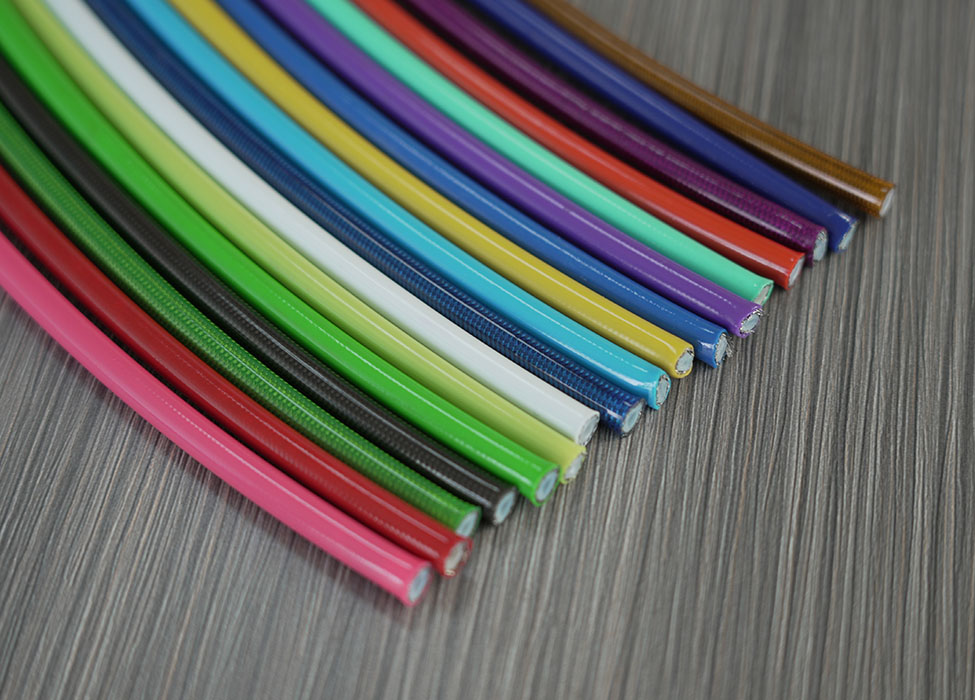
Outer jackets (PVC, nylon sleeve or painted braid) provide UV, abrasion and corrosion protection. Selection should be driven by application: colored jackets for motorcycles, heavier coatings for coastal or salted-road fleets.
Performance benefits compared with rubber hoses
Reduced hydraulic compliance — better pedal / lever feel
Transmission of master-cylinder displacement
Radial expansion in rubber hoses absorbs part of master-cylinder displacement; PTFE assemblies constrained by stainless braid significantly reduce that effect. The result is a firmer, more repeatable pedal or lever with improved modulation under repeated braking.
Thermal and long-term stability
Consistent behavior under cycling
PTFE maintains dimensional stability across a wide temperature range; combined with braid restraint, assemblies preserve performance from cold starts to high-temperature track conditions.
Lower lifecycle maintenance cost
Durability vs total cost of ownership
Although unit cost is higher than rubber hoses, PTFE stainless-braided lines typically require fewer replacements and produce fewer warranty claims—reducing lifecycle cost for fleets and resellers.
Specification & procurement checklist (engineer’s RFQ)
Hydraulic and dimensional specs
Nominal inner diameter (ID) & flow match
Specify ID to match master cylinder/caliper volumes. Include AN/metric equivalence and acceptable tolerances in the RFQ to avoid mis-sizing.
Working pressure, burst pressure & impulse testing
Require working and burst pressure tables per size and batch impulse (cyclic) test certificates. Define safety factors and test protocols in purchase terms.
Mechanical & fitment specs
Minimum bend radius & length tolerance
Provide routing diagrams and request minimum bend radius and length tolerances to prevent PTFE core kinking during installation.
Fittings, materials & termination quality
Specify fitting type (banjo, AN, OEM), mating material preference (stainless vs plated), crush washer spec and torque values. Demand documented crimp tooling calibration or factory assembly certification.
Quality assurance
Traceability & acceptance documents
Make batch pressure test reports, material certificates, and pre-shipment test records mandatory acceptance documents for volume orders. Include rejection criteria for dimensional or pressure deviations.
Installation, inspection and maintenance
Routing and mechanical protection
Clamp strategy and heat management
Route with smooth radii, secure with vibration-resistant clamps, and avoid proximity to exhaust without thermal shielding. Use anti-chafe sleeves where contact is unavoidable.
Torque control and system bleeding
Assembly discipline
Use calibrated torque wrenches and follow supplier torque tables; always replace crush washers. After installation, replace brake fluid with the correct DOT grade and perform a staged bleed to eliminate entrapped air.
Inspection intervals
What to log
Inspect outer jacket, braid exposure, clamp wear and fitting deformation at regular intervals. Record batch numbers, installer ID and torque readings to simplify warranty handling and root-cause analysis.
Common failure modes & mitigations
Improper termination
Mitigation: insist on factory crimp certification or audited crimp tooling and include termination inspection criteria in incoming QC.
Abrasion and chafe
Mitigation: optimize clamp placement, add protective sleeves and route away from high-wear contact points.
Thermal degradation
Mitigation: apply heat shielding and select jackets rated for the application's temperature range.
Conclusion
PTFE stainless-braided brake hoses are an engineered solution combining low hydraulic compliance, thermal/chemical stability and mechanical protection—delivering measurable improvements in braking response and lifecycle reliability. For procurement teams and distributors, strict RFQ requirements (ID matching, pressure/impulse data, termination certification and batch traceability) are essential to realize these field benefits and reduce total cost of ownership.