
Stainless Steel Braided Brake Hose Inspection and Replacement Guide
A brake hose may look simple from the outside, but it is an important part of a hydraulic braking system. For motorcycles and modified vehicles, the hose must withstand hydraulic pressure while also handling vibration, steering movement, suspension travel, heat and environmental exposure.
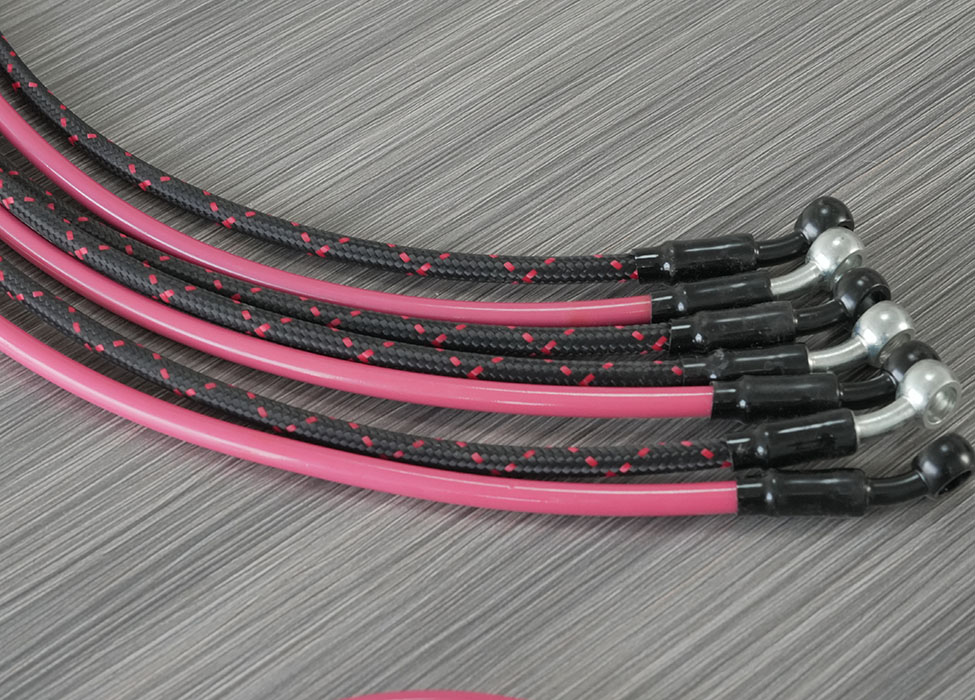
Stainless steel braided brake hoses are widely used in aftermarket and performance applications because their reinforced construction can provide controlled expansion characteristics compared with some conventional rubber hose designs.
For motorcycle riders, workshops and international brake component buyers, knowing when to inspect or replace a brake hose is just as important as choosing the correct product.
What Does a Stainless Steel Braided Brake Hose Consist Of?
Inner Tube
The inner tube carries the brake fluid. Depending on the product design, the inner material may be PTFE, nylon, rubber or another material specified for the application.
Reinforcement Layer
The reinforcement layer supports the inner tube under hydraulic pressure. Stainless steel braid is commonly used in performance-oriented brake hose constructions.
Outer Protection
An outer covering or protective layer can help reduce abrasion and environmental exposure. Different applications may require different protection depending on routing and operating conditions.
Fittings and Crimped Connections
The hose itself is only one part of a complete brake line. Fittings and crimped connections must match the vehicle and brake components and must be assembled correctly.
Seven Signs That a Brake Hose Should Be Inspected
1. Brake Fluid Around the Fitting
Fluid around a fitting or connection should never be ignored. The cause needs to be identified before the vehicle is returned to normal operation.
2. Damaged Stainless Steel Braid
Broken, severely deformed or heavily worn braid can indicate mechanical damage or incorrect routing.
3. Cracked Outer Cover
Cracks, cuts or severe deterioration of an outer protective layer can expose the underlying hose construction to additional environmental and mechanical stress.
4. Abnormal Hose Bulging
Any unusual bulging or deformation should be investigated. It can indicate deterioration or an internal problem and should not be treated as normal aging.
5. Severe Kinking
A hose should not be forced into a sharp bend. Severe kinking can affect the hose structure and should be corrected or replaced where necessary.
6. Change in Brake Lever Feel
A soft or inconsistent lever feel can have many possible causes, including air in the system, brake fluid condition, caliper problems or hose-related issues. The hose should therefore be included in the inspection rather than assuming the hose is automatically responsible.
7. Incorrect Routing After Modification
If handlebars, forks, calipers or suspension components have been modified, the existing brake hose may no longer have the correct routing or length.
How to Inspect a Motorcycle Brake Hose Step by Step
Step 1: Inspect the Entire Hose
Do not inspect only the visible section near the master cylinder. Follow the hose from the master cylinder to the caliper and inspect the complete route.
Step 2: Inspect Both Ends
Check fittings, sealing areas and crimped sections for leakage, deformation or abnormal movement.
Step 3: Check Steering and Suspension Movement
Move the motorcycle through its normal steering range and inspect the hose position. For systems affected by suspension movement, ensure sufficient clearance throughout the operating range.
Step 4: Look for Contact Points
Identify any point where the hose may rub against the frame, fork, wheel, brake disc, suspension component or other moving part.
Step 5: Check After Installation
After a new brake hose is installed, confirm routing, fitting orientation, connections and system bleeding before road use.
When Is It Time to Replace the Brake Hose?
A brake hose should be considered for replacement when there is visible structural damage, leakage, severe deterioration, damaged fittings or an installation problem that cannot be corrected without replacing the assembly.
There is no universal replacement period that applies to every motorcycle or vehicle. The correct replacement decision should consider manufacturer recommendations, product construction, age, environment, usage and actual hose condition.
How to Select a Replacement Brake Hose
Match the Hose Length
The replacement hose should provide sufficient length for the intended routing without leaving excessive slack.
Match the Fittings
Thread specification, fitting type, banjo size and fitting angle should be confirmed before ordering.
Choose the Appropriate Material
Different applications may require different hose materials.
For PTFE-based applications, our Teflon Brake Hose provides a suitable starting point for customized projects.
For lightweight and flexible applications, buyers can also consider our Nylon Brake Hose.
For complete assemblies, our Nylon Brake Hose Assembly provides an assembled solution rather than loose hose material.
Consider the Complete Brake System
The hose should be selected together with the master cylinder, caliper, brake fluid, fittings and intended vehicle application. A brake hose should never be selected only because its appearance matches the vehicle.
Stainless Steel Braided Brake Hose vs Conventional Rubber Hose
Both constructions have their own application areas.
Advantages of Reinforced Braided Construction
- Controlled expansion characteristics under hydraulic pressure
- Good resistance to external abrasion when properly protected
- Suitable for many modified and performance brake applications
- Can provide a more direct and consistent lever or pedal feel when correctly designed
- Suitable for customized lengths and fitting configurations
Advantages of Rubber Brake Hose Construction
- Widely used in original-equipment applications
- Flexible and familiar to many vehicle manufacturers
- Suitable for many conventional replacement applications
- Available in complete assemblies for different vehicle applications
For conventional replacement applications, our Rubber Brake Hose Assembly can be specified according to the required application.
What International Buyers Should Check Before Ordering
Technical Information
- Inner hose material
- Outer reinforcement
- Hose inside and outside diameter
- Working pressure requirements
- Temperature requirements
- Brake fluid compatibility
- Fitting type
- Thread specification
- Fitting angle
- Overall hose length
OEM and Aftermarket Requirements
OEM buyers may provide drawings or samples, while aftermarket distributors may order according to motorcycle model, year and brake configuration.
Providing accurate technical information at the beginning of the project helps reduce sample revisions and incorrect production.
FAQ: Motorcycle Brake Hose Replacement
How often should motorcycle brake hoses be replaced?
There is no universal replacement interval. Regular inspection and the manufacturer's maintenance recommendations should be followed. Replace the hose when its condition indicates deterioration, leakage, structural damage or other problems.
Can upgrading the brake hose improve brake feel?
A properly designed reinforced hose can reduce radial expansion compared with some conventional hose constructions, which may contribute to a firmer or more consistent lever feel. However, overall brake performance depends on the complete hydraulic system and correct installation.
Are stainless steel braided hoses suitable for all motorcycles?
No. The correct hose must match the motorcycle's brake system, fitting dimensions, thread specifications, routing, length and operating requirements.
Should I choose PTFE, nylon or rubber?
The correct choice depends on the application. PTFE can be suitable for performance-oriented and demanding applications, nylon can be useful where flexibility and weight are important, while rubber remains widely used for conventional OEM and replacement applications.
Can a brake hose be customized according to a drawing?
Yes. For OEM and aftermarket projects, brake hose assemblies can be developed according to drawings, samples, hose length, fitting specifications, fitting angles and other technical requirements.
Our Main Brake Hose Products
Our main product range covers different hose materials and complete assemblies for motorcycle, automotive and modified brake applications.
- Teflon Brake Hose
- Nylon Brake Hose
- PTFE Brake Line Assembly
- Nylon Brake Hose Assembly
- Rubber Brake Hose Assembly
- Motorcycle Brake Lines
Customized Motorcycle Brake Lines for OEM and Aftermarket Projects
For motorcycle parts distributors, wholesalers, repair shops and brake system suppliers, different models often require different hose lengths, fittings and routing configurations.
We support customized brake hose projects based on customer drawings, samples and technical specifications. This allows buyers to develop products for specific motorcycle models and aftermarket applications instead of relying only on standard hose sizes.
For drawings, samples, product specifications or bulk order requirements, please visit our Contact page.
Conclusion
Regular inspection is one of the simplest ways to maintain a motorcycle brake system. Stainless steel braided brake hoses should be checked for braid damage, leakage, abnormal bending, fitting problems and incorrect routing.
When replacement is necessary, selecting the correct material and complete hose specification is more important than simply choosing a visually attractive brake line.
For OEM and aftermarket buyers, a properly specified brake hose can provide a practical solution for different motorcycle and vehicle applications while allowing customization of length, fittings and construction.